Stay up to date on our latest projects, insights, and team news.
Design research Watersystem Noord‑Nederland

Flux is working on an integrated exploration of the water and soil system in the northern Netherlands. The aim is to gain a clear understanding of how the current system functions, how climate change is affecting it, and what spatial choices these developments require.
Through this research by design, we are investigating the relationship between above- and below-ground systems, the pressure climate change places on freshwater availability, and the implications for future land use. The analysis focuses on strategic challenges such as freshwater supply, water storage and the necessary adjustments to land use for nature, agriculture, drinking water extraction and the energy transition.
The result will be an integrated perspective that places water and soil at the heart of spatial planning decisions in the northern Netherlands.
Commissioned by: the MooiNL programme.
In collaboration with: the Ministry of Agriculture, Fisheries, Food Security and Nature; the Ministry of the Interior and Kingdom Relations; and the provinces of Fryslân, Groningen and Drenthe.
Stadseiland Utrecht

How can a growing city create more space for nature, movement and everyday life? In 2017, Flux Landscape Architecture, together with BURA and HIK-ontwerpers, developed a vision for Stadseiland Utrecht as part of the *Think Big!/Shared Space* initiative. The team explored how a significant share of Utrecht’s future urban growth could be accommodated in this area while preserving and strengthening its identity as an urban island. Commissioned by Architecture Centre AORTA.
A key element of the vision is the *Rondje Stadseiland*: a continuous linear park along the Merwede Canal and the Amsterdam-Rhine Canal. In Utrecht-West, where large-scale housing developments are taking place, this creates a green structure connecting neighbourhoods and waterfronts. The plan identifies five distinct areas, each with its own character, together forming one continuous route. Bridges and cross-connections link the park to surrounding neighbourhoods, create smaller walking and cycling loops, and connect the area to wider cycling and running networks. The result is a new public space that encourages movement and social interaction.
From the outset, Flux’s ambition was clear: to develop the city and landscape as one coherent whole. So that urban growth delivers not only more homes, but also a better-connected and more liveable Utrecht.
The Municipality of Utrecht is now further developing the concept and inviting residents to contribute their ideas.
Climate-Adaptive Stations shortlisted for the NVTL Awards!

Flux has been shortlisted for the NVTL Awards with its project Climate-Adaptive Railway Stations, in the Research by Design category. Selected from numerous submissions, the project was recognised for its societal relevance and systematic approach to climate adaptation in railway station environments.
Through an analysis of 25 railway stations across the Netherlands, the research identifies the diverse climate challenges at each location. These insights have been translated into specific climate profiles and practical strategies, providing guidance on how station environments can better respond to the impacts of climate change.
The research project Climate-Adaptive Railway Stations was commissioned by Bureau Spoorbouwmeester, NS and ProRail.
▸ The NVTL Awards ceremony will take place on Friday, 27 November, from 15:00 at De Baanderij, NDSM, Amsterdam. Registration is required.
Four Courtyard Gardens for Merwede

Along the Merwede Canal, a vibrant, high-density and sustainable urban district is taking shape, bringing together living, working and social interaction. Flux is designing four communal gardens that together form a robust green network, contributing to a climate-resilient and biodiverse living environment.
▸ The Neighbourhood Park (Block 8) is currently under construction. This spacious inner courtyard has a park-like character, with semi-paved paths, play features and various places to relax and meet. Trees and shrubs planted on top of the underground parking garage create a rich, layered green landscape.
▸ The Nature Garden (Block 9) is designed as a gently wild oasis in the heart of the city. A lowered ground level collects and stores rainwater, while a ‘floating’ pathway allows for maximum greening. Integrated seating areas along the route offer views of the green landscape.
▸ The City Garden (Block 10) combines reused paving bricks and a water feature to create the atmosphere of an intimate courtyard. Nectar-rich planting attracts insects and enhances the garden’s ecological value.
▸ The largest garden (Block 7) focuses entirely on climate adaptation, with cooling, water retention and generous greenery at its core. Walking routes connect the different areas, creating a green outdoor experience in the heart of Merwede.
Together, the gardens provide a habitat for birds, insects and small mammals, while also creating a social framework for residents. The green spaces and rooftop gardens extend the living environment beyond the home, offering a sheltered, shared outdoor world within a dense urban setting.
Commissioned by: Synchroon and AM Gebiedsontwikkeling.
In collaboration with: LEVS architecten, KCAP, NL Architects, Paul de Ruiter Architects, MONK architecten, Studio Nauta, Zecc Architecten, Van Rossum and Techniplan Adviseurs.
Flux team: Robert Kapel, Britt Piek
Flux excursion Barcelona

Flux went on an excursion to Barcelona! The team explored the city and visited around 32 projects across Barcelona, ranging from renewed public spaces and urban transformations to distinctive places and new developments. Among the projects visited were Can Batlló, Parc de les Glòries, Carrer de Cristóbal de Moura, Carrer del Comte Borrell and Parc Joan Miró.
The projects offered a wide range of perspectives on high-quality public spaces, climate adaptation, mobility and urban densification, providing fresh insights and inspiration for Flux’s own projects.
A special thanks to Marina Cervera Alonso de Medina for her insightful presentation on Barcelona’s green strategy, sharing the city’s ambitions and approach to green spaces and urban development.
De Kuil Rotterdam completed!

Flux’ project De Kuil Rotterdam has been completed, a project together with Roffaa Architecture, XML Architecture Research Urbanism and Heijmans. Located at the intersection of Kop van Zuid, Parkstad and the Afrikaanderwijk, De Kuil adds 232 homes of various typologies and a new public space to the area. The project creates a green transition zone where existing and new residents can come together.
The landscape forms the starting point of the design. De Kuil is sheltered within the basin of a dike, a distinctive landscape setting that has been translated into a contemporary valley. The green inner courtyard features subtle changes in elevation that naturally collect, retain and gradually infiltrate rainwater into the soil. This creates a climate-adaptive water system that manages heavy rainfall, helps mitigate drought and, at the same time, provides an attractive green living environment.
The terraced buildings open towards the green heart of the development. Green terraces create a gradual transition between the homes and the shared courtyard, allowing architecture and landscape to merge. An interconnected network of walking paths links the two central squares – the Mist Square and the Neighbourhood Square – with the dike and surrounding neighbourhood. On warm days, misting installations at Mist Square provide cooling, creating a comfortable outdoor environment for residents and visitors.
Planting plays a key role in the functioning of the landscape. A layered composition of trees, shrubs, perennials and herbs creates a natural and resilient character throughout the year, while providing food, shelter and nesting opportunities for birds, bees, butterflies and other insects. The tree canopies provide shade and reduce heat stress, while the vegetation retains rainwater and stimulates evaporation. The result is a robust, nature-inclusive landscape where climate adaptation, biodiversity and quality of outdoor spaces go hand in hand.
By integrating landscape design, climate adaptation and social interaction, De Kuil is more than an attractive residential environment. It is a future-proof urban landscape that contributes to a healthier and more resilient Rotterdam.
De Kuil has been nominated for the Rotterdam Architecture Prize 2026, organised by AIR – Architecture Institute Rotterdam.
Flux wins WLA Award of Excellence!

Time to celebrate! Flux has won the World Landscape Architecture Award of Excellence. Selected from entries from more than 25 countries, Flux received this year’s award in the Concept | Residential Landscape Design category for the Stadsdommel Eindhoven spatial vision. Congratulations to our clients and project partners! We are proud to receive this international recognition of our work.
The Dommel River, currently still largely hidden within the city, has the potential to become a strong green-blue structure that provides space for both people and nature. This approach creates new connections between the city of Eindhoven and its surrounding landscapes.
The Stadsdommel vision seeks to balance ecological values with the growing need for high-quality public space in an increasingly dense urban environment. It establishes a green framework through the city, offering places for nature, relaxation, movement and social interaction. Wildlife gains valuable habitat, while residents and visitors find spaces to stay, walk and play. The area develops a distinctive identity as an urban landscape where city and nature reinforce one another.
By viewing the Dommel as part of a broader river valley system —the urban Dommel corridor— new opportunities emerge for development within the urban fabric. This corridor includes not only the river and its banks, but also connecting routes, public spaces and adjacent areas.
Commissioned by the Municipality of Eindhoven.
Flux project team: Gerwin de Vries, Sam van den Oetelaar, Tom van Heeswijk and Bram van Raaij.
Municipality of Eindhoven project team: Dennis Kaspori, Bart van Eijk, Katinka Bust, Joost Ossevoort, Karel Beljaars, Ronald Rijnen, Vera Gielen and Manon Grond.
Groene Scheggen Nominated for the WLA Awards!

Flux has been nominated for the shortlist in two categories for the World Landscape Architecture Awards. From more than 275 entries worldwide, Flux was selected for the Conceptual—Residential Landscape Design category and the Conceptual—Analysis & Planning category.
In the Conceptual Analysis & Planning category, the plan for the “Groene Scheggen” was selected. The Groene Scheggen represent a spatial strategy to ensure that urban growth and landscape development in the NOVEX Arnhem Nijmegen Food Valley area proceed in harmony. With 100,000 homes planned for the NOVEX area, the landscape is under significant pressure. The “Scheggen” offer an alternative here: not residual areas between cities, but rather buffer zones that serve as a link between the city and the landscape. They focus on a diverse landscape of agriculture, nature, and recreation, thereby preventing urbanization and other land-use demands from taking over everything. Commissioned by Groene Metropoolregio Arnhem-Nijmegen (GMR) – regio Arnhem-Nijmegen and Regio Foodvalley.
The winners of the WLA Awards will be announced on July 21.
Projectteam Flux: Gerwin de Vries, Kris Kersten, Kasper Neeleman, Marleen Buitenwerf, Bram van Raaij, Isabelle P.
Projectteam Groene Scheggen: Mathieu Schouten and Karlijn Looman
Scheveningen, City in the Dunes

Flux landscape architecture presents the design study “Scheveningen – City in the Dunes,” commissioned by Gemeente Den Haag. The central question: How can Scheveningen prepare for a sea-level rise of up to 5 meters, while simultaneously working to create a livable, green, and future-proof coastal city?
The project demonstrates that a transition from hard to soft measures is necessary. In the short term, low walls, piers, and stairs are needed to ensure water safety. In the long term, space will be created for a new dune landscape that both protects Scheveningen and connects it to the sea. This dune landscape offers opportunities for greening, biodiversity, recreation, and a mobility transition centered on pedestrians, bicycles, and public transportation.
With this vision for the future, water safety becomes not only a technical challenge but also a catalyst for a more attractive and climate-resilient Scheveningen. In collaboration with the Delfland Water Board, Deltares, and Goudappel.
Project team, Municipality of The Hague: Marlies Augustijn, Arthur Hagen, Fangfei Schutte-Liu, Beate Begon, Ferry Taal
Projectteam Flux: Gerwin de Vries, Robert Kapel, Kasper Neeleman, Tim Gämperle, Paula Rydel
Development Vision for the Brabantse Wal

Flux landscape architecture and Haskoning, in collaboration with eighteen local partners, have drawn up a development vision for the Brabantse Wal that provides direction for a robust spatial plan for the next 25 years. The project has one clear goal: to make the landscape resilient, biodiverse, and future-proof by using water and soil as guiding principles.
The plan focuses on creating an attractive landscape that retains water, restores seepage flows, and improves soil health. Within the Brabantse Wal, the transition to regenerative agriculture is being encouraged, ecological corridors are being strengthened, and smart combinations of functions are being sought for housing, energy, recreation, and defense. Cultural-historical structures are made more visible in the landscape and utilized as a green framework for new spatial claims within the landscape of the Wal.
The development perspective is not a blueprint but a shared compass: a vision map with transition principles and spatial guidelines that offers everyone in and on the Brabantse Wal a framework for future decisions. Commissioned by the Provincie Noord-Brabant.
Projectteam Haskoning: Hans Büchi, Bert Groffen, Onno de Vrind, Brigitte Bakker, Beau Smit
Projectteam Flux: Bram Willemse, Sam van den Oetelaar, Martijn Bisschops, Klaudia Dočekalová
Climate-Resilient Weteringen in the Land of Maas and Waal

Flux is working on a vision document and feasibility study for the Oude Wetering and the Nieuwe Wetering: two landscape structures that form the heart of the Land van Maas en Waal. The assignment is part of the Groene Mantel regional process, in which governments and partners are collaborating on a single, coherent green-blue framework for the region.
The goal of the study is to establish a spatial foundation for the realization of climate-resilient waterways and their surrounding zones. Water safety, ecology, recreation, and agriculture are all integrally considered in this process.
Through this research, we are working toward waterways that function not only as water carriers but as complete landscape systems that strengthen the region in the long term.
Commissioned by the Groene Metropoolregio Arnhem-Nijmegen (GMR) – regio Arnhem-Nijmegen and in collaboration with Waterschap Rivierenland, Provincie Gelderland, Gemeente Druten, Gemeente Beuningen, Gemeente Wijchen, Gemeente Nijmegen and gemeente West Maas en Waal.
Wilhelminaplein officially Opened!

Last week, Wilhelminaplein in Eindhoven was officially opened with a festive celebration. The goal of creating a green square that aligns with the Eindhoven Green Vision has thus become a reality.
The Eindhoven Green Vision is a study by Flux that examined how the center of Eindhoven can be made greener. Wedges, lines, and spaces play an important role in this, and one of those spaces is Wilhelminaplein.
Flux transformed this paved traffic square into a future-proof and climate-adaptive square where cars are merely guests. The square has a green and lively character, with green borders at the ends and planting beds that fan out toward the center of the square. There is space here for outdoor dining areas, the weekly market, and other events that make the square an important gathering place.
Trees with light-permeable canopies can grow to full size while the distinctive facades remain visible. The trees provide shade, helping to cool the area on hot days and boosting biodiversity. Rainwater is collected in the planting beds, which helps mitigate flooding during heavy downpours and creates a variety of ecological habitats. The natural stone edging of the planting beds gives the square a robust appearance and, in some places, forms seating areas that encourage people to linger on the square. Wilhelminaplein is thus an important space for a livable, healthy, and future-proof city.
Commissioned by Gemeente Eindhoven, together with LITH Advies and constructed by Heijmans.
Projectteam Flux: Gerwin de Vries, Sam van den Oetelaar, Tom van Heeswijk, Britt Piek
Domus Amsterdam

Flux designed the courtyard garden at the Houthavens in Amsterdam, in collaboration with Shift architecture. The Houthavens, once the bustling heart of the timber industry, have been transforming in recent years into a modern and sustainable residential and commercial district. In this innovative urban area, the courtyard garden serves as a green oasis, a place where residents and visitors can relax, meet, and unwind.
The robust, natural vegetation of the courtyard garden brings vitality and contributes to greater biodiversity. Various seating areas invite people to meet and relax, while also providing outdoor workspaces. The vegetation gradually transitions into semi-paved surfaces and, in some places, grows alongside stepping stones, creating a natural and dynamic system.
Rainwater is collected in the courtyard garden, trees provide shade for cooling, and the variety of vegetation attracts birds and insects. This creates a livable and sustainable environment in which architecture and landscape reinforce each other. Commissioned by Synchroon and in collaboration with Shift architecture urbanism.
Vision for Amersfoort Station District Finalized
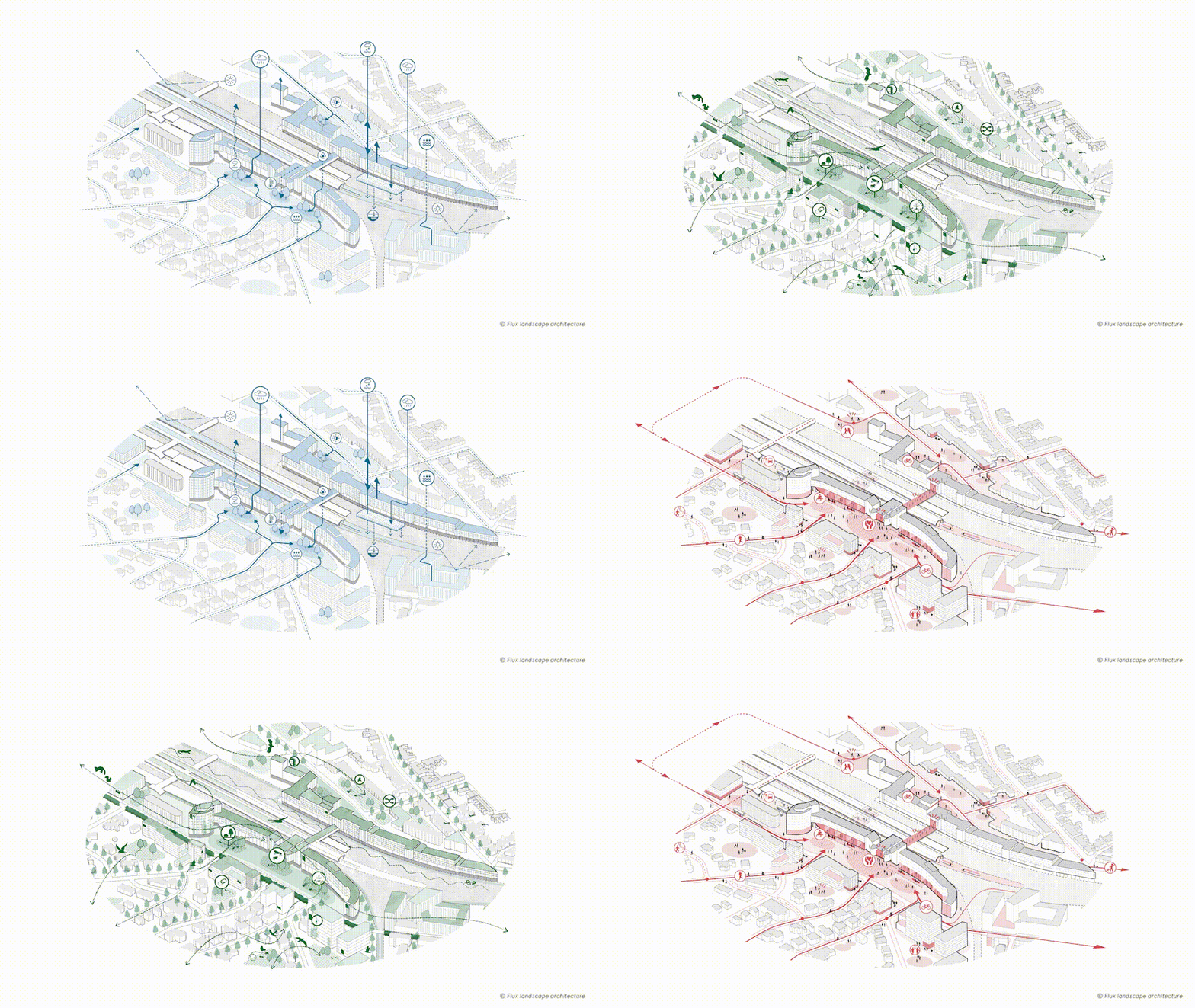
Over the past period, Flux collaborated with Civic and Witteveen+Bos on a future-proof vision for the Amersfoort Centraal station district. Amersfoort is growing, and with it, pressure on the station area is increasing. In addition, the current station area is heavily paved, amenities are insufficient, and routes for pedestrians and cyclists require attention. The station vision focuses on effective routing, stormwater management, and greening with shaded areas to combat heat stress, ensuring a future-proof and pleasant experience in the station area.
Commissioned by the Gemeente Amersfoort, Provincie Utrecht, NS Stations, ProRail and Bureau Spoorbouwmeester, and in collaboration with Civic – Public Architecture and Witteveen+Bos.
First phase Hoefkwartier Amersfoort has started!

With the construction of Lichtpenweg, the transformation of the Hoefkwartier has now truly begun. Flux is working on the design for the new public space in the area. The Hoefkwartier is transforming from an office district—where 3,500 to 4,000 new homes will be built—into a vibrant urban neighborhood where living, working, and learning come together. The public space will be designed with maximum greening as the guiding principle. As a result, streets, squares, and the Hoefpark will have as much space as possible for trees, plants, and a pleasant environment for people to spend time in. Cars will have limited space, while pedestrians and cyclists will take center stage in green, low-traffic streets. This green design enhances biodiversity, climate resilience, health, and the neighborhood’s livability. This transformation is commissioned by the City of Amersfoort, and we are carrying it out in close collaboration with SmitsRinsma.
Galgenwaard Urban Design Program Approved!
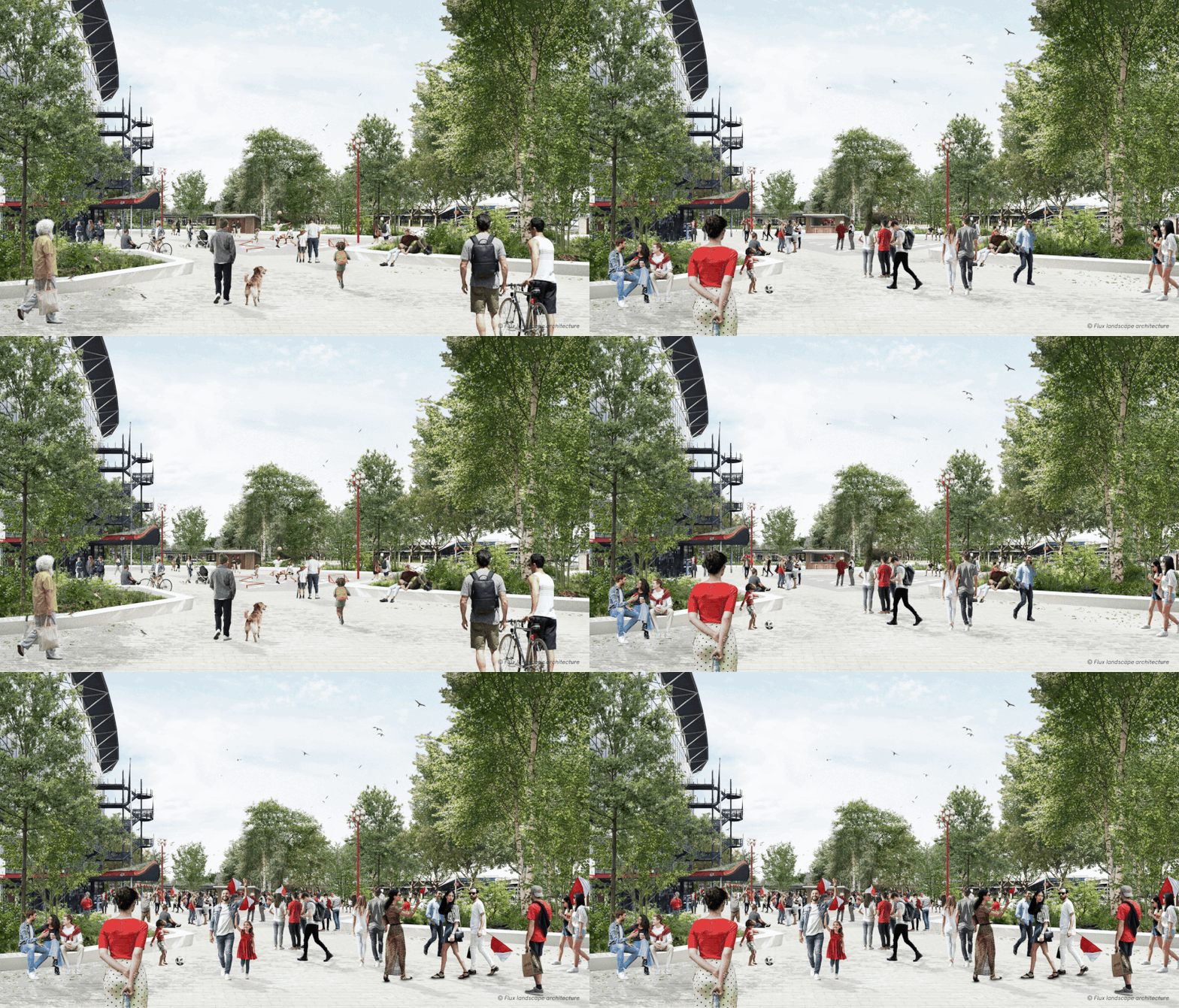
Flux Landscape Architecture is working on the development of Galgenwaard on behalf of the City of Utrecht. With the approval of the Urban Design Program (SPvE), a major step has been taken toward creating a future-proof urban area. The public space surrounding the Galgenwaard Stadium will receive a quality upgrade, closely aligned with the planned urbanization of the area. Whereas the stadium area was long dominated by peak activity during matches, it is now being transformed based on the “park square” concept. This concept provides space for match attendees as well as pleasant areas to relax and enjoy recreational activities. The dynamics of peak times during matches, greening, and climate-adaptive measures have been integrated into the design to capture water, reduce heat stress, and create a healthy, attractive living environment.
Commissioned by the City of Utrecht and in collaboration with MVSA Architects, Galgenwaard Development, Jongerius Invest, and FC Utrecht.
Projectteam Gemeente Utrecht: Wesley Zwarts MSc, Etienne De Jager, Vincent Peters, Casper van Calsteren
Projectteam Flux: Gerwin de Vries, Mayke Baltussen, Tim Gämperle, Pascale Mondion Klapp, matthijs gubbels
Bridge and decking Erasmusveld The Hague completed

The pedestrian bridge and decking in the Proeftuin Erasmusveld in The Hague have been completed. The new wooden bridge connects the northern part of the park with the southern part of the Proeftuin, a sustainable residential area alongside the ecological zone. The wooden decking is situated next to the water garden. Here, aquatic plants filter the water, creating a valuable habitat for fish and birds.
Flux has been involved in the Proeftuin Erasmusveld since winning the tender in 2018. Flux worked on, among other things, the northern section of the park, the landscape and the inner deck of the Leyhof residential building, which have now been completed. The bridge and decking were commissioned by Gemeente Den Haag, in collaboration with Waalpartners, and constructed by Aannemersbedrijf Damsteegt B.V Waterwerken.
Preliminary design for Veur-Lent presented

Flux is working on a landscape design for the Nijmegen city island of Veur-Lent. Over the coming years, the current open grassland will be transformed into a layered river park, where differences in elevation, natural vegetation and a dense network of paths will provide space for ecology, recreation and social interaction.
After a broad city survey, the municipality of Nijmegen opted for a green development of the island. Together with residents, entrepreneurs and nature organisations, a programme of requirements was drawn up, which Flux has now translated into a preliminary sketch design. Strengthening the open space, making the river dynamics tangible and developing robust green structures form the core of this perspective.
The design focuses on the area between the Het Bastion water sports centre and the Lentloper. Excavating parts of the area will create a natural transition to the Spiegelwaal. New paths, rugged bank vegetation and open spaces will create a varied and socially safe landscape. Around Het Bastion, there will be space for sports and games, in further coordination with the surrounding area.
Veur-Lent will thus grow into a park with character: a green lung for Nijmegen, where river, landscape and city reinforce each other. In the coming years, the municipality will work towards a provisional and final design; realisation is expected to start in 2028. Commissioned by the Municipality of Nijmegen.
Municipality of Nijmegen: Merijn van Loon, Paul Goedknegt, Cecyl Slijkhuis, Leonardo Marchese, Suzan van den Heuvel
Flux landscape architecture: Gerwin de Vries, Marleen Buitenwerf, Kasper Neeleman, Tobias Macchione
Landscape quality guide Venray

Flux landscape architecture created a landscape quality guide for the municipality of Venray. The municipality of Venray faces major spatial challenges: housing construction, energy transition, agricultural change, climate adaptation and nature development are placing increasing pressure on the countryside. The Landscape Quality Guide has been developed to guide these developments.
The guide begins with the landscape’s DNA: the historical development of peatlands, sandy soils, stream valleys, and the Meuse Valley forms the basis for nine distinct sub-landscapes, each with its own identity, qualities, and carrying capacity. The guide then visualizes the spatial demands of transition challenges. By stacking these demands—from agricultural transition to energy transition and climate adaptation—it becomes clear where the pressure is greatest and the “carrying capacity” of each sub-landscape.
Finally, the guide outlines a future perspective: for each sub-landscape, it indicates which functions are appropriate, which qualities can be strengthened, and which developments are undesirable. In this way, the Landscape Quality Guide helps the municipality of Venray to maintain control and find a balance between protection and development and to build a future-proof rural area. In collaboration and commissioned by the municipality of Venray.
Goudsesingel Rotterdam, from city boulevard to sponge park

At the 2025 Stadmakerscongres (City Makers Congress), Flux will present its design research on the Goudsesingel in Rotterdam: From City Boulevard to Sponge Park.
Extreme heat, drought, and flooding call for a radical greening of Rotterdam’s city center. By rethinking mobility, the wide city boulevards from Van Traa’s Basic Plan can play a key role in the transition to a green, cool, and healthy city. The Goudsesingel is a pioneer in this process: its transformation into a linear sponge park offers space for water storage, cooling, biodiversity, and urban development.
During this workshop at the Stadmakerscongres, we will discuss the vision for 2125 and explore the steps needed to develop the street into a linear park where a robust water system collects and stores rainwater while simultaneously contributing to a healthy living environment for people, plants, and animals. The Goudsesingel design research project was commissioned by the Municipality of Rotterdam, and the Stadmakerscongres is organized by AIR – Architecture Institute Rotterdam.
Utrecht scenario study presented

In the summer of 2025, Flux presented the results of the Utrecht 2100 scenario study to the Provincial Council Committee. Four integrated future scenarios for the year 2100 were developed and compared with the existing Environmental Vision. Using maps, systemic cross-sections and inspiring atmospheric images, spatial opportunities and bottlenecks were identified, highly and low-dynamic areas were identified, and no-regret measures for water and soil management were formulated. The study produced clear recommendations for the seven themes from the Environmental Vision and offers policymakers indispensable tools to make the province of Utrecht climate-adaptive, circular and economically vital, and to further refine the Environmental Vision for 2050. Commissioned by the Provincie Utrecht.
Flux wins WLA award with Dordrecht Citypark!

Time to celebrate! Flux has won two World Landscape Architecture Awards. The projects Stadspark Dordrecht XXL and Almere Highnote were both honored with the “Outstanding Award.” An international jury selected the projects from more than 300 submissions worldwide.
Dordrecht is committed to the city’s growth and aims to utilize and enhance all its existing qualities. The Dordtwijkzone, with its numerous sports fields and facilities, and its sometimes hidden, park-like and scenic character, offers opportunities to transform this zone into a new city park.
In Flux’s vision, the sports fields, the park-like landscape, and connections to the surrounding area will converge, creating a vibrant and green heart of the city: the new Stadspark Dordrecht. The park offers space for relaxation, sports, experiencing nature, and biodiversity. A central role is reserved for the 10-kilometer park run: a wide, smooth path suitable for walking, cycling, running, and skating. Commissioned by the Municipality of Dordrecht, Flux developed the vision and development of the park design, focusing on routes, greenery, water, programming, and features. The integration of sports facilities, more nature, and water makes the park more robust and climate-resilient.
Outstanding Award
Dordrecht City Park | Flux landscape architecture
Concept – Masterplan and Urban Design
Commissioned by the Municipality of Dordrecht